

A research path of the University of Salerno, developed with Russo Distillers 1899, which ennobles agricultural waste from Campania by transforming it into bitters, cordials, and blended products with a strong territorial identity.
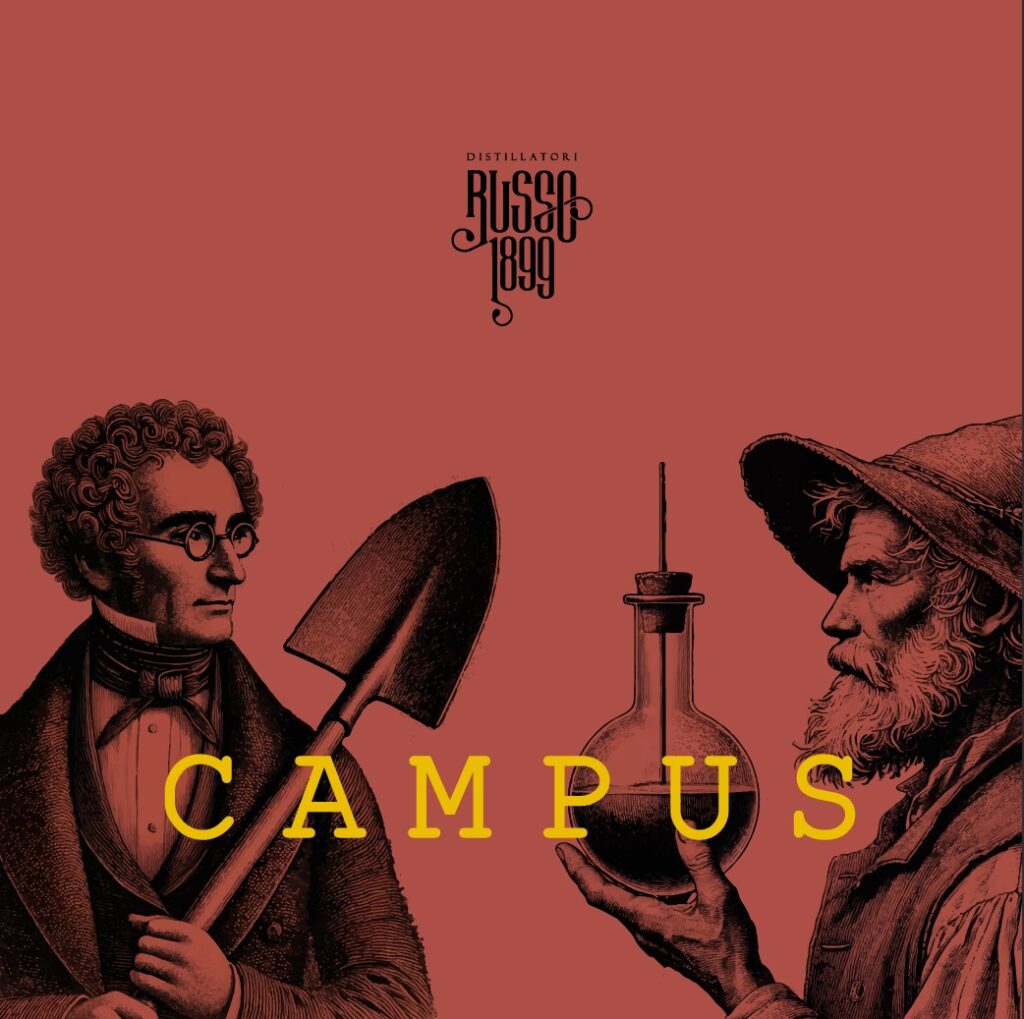
There's an image that runs through the entire Campus Alchemist project: that of two fields of knowledge that meet without ever overlapping. On one side, scientific knowledge, rigorous and methodical; on the other, agricultural and productive wisdom, built in the field and consolidated over time. It is in this space of dialogue that the Campus Alchemist project is born. Campus Alchemist, a line of liqueurs resulting from the collaboration between theUniversity of Salerno and Russo Distillers 1899, concrete outcome of the I-Pro Med research project.
Campus Alchemist It's not a declaration of intent, nor a rhetorical exercise in sustainability. It's a practical project, starting with research and ending with the glass, with a clear objective: to demonstrate that agricultural waste can become a valuable raw material, maintaining—and in some cases improving—the organoleptic characteristics of products obtained from the noble parts of the fruit.
From waste to raw material
The work is born within the Department of Pharmacy, University of Salerno, where botanists and chemists have developed extraction, infusion, and distillation techniques capable of recovering aroma, structure, and sensory stability from what is normally excluded from the production cycle. Peels, fibrous residues, and unmarketable parts thus become resources, according to a circular economy model that reduces environmental impact and opens up new industrial opportunities.
The selected botanicals tell the story of a precise, never generic, agricultural Campania: the Auletta artichoke, the Paestum pomegranate, the San Valentino Torio fennel, the locally grown wild butcher's broom, the San Marzano tomato from the Agro Nocerino-Sarnese area. These deeply identifying ingredients are reinterpreted through the filter of scientific research and translated into a contemporary, fluid grammar.
Liquors that speak Campanian
The Campus Alchemist line moves consistently between bitters, cordials, and low- or zero-alcohol products, maintaining a common stylistic signature: aromatic purity, balanced flavors, and a gastronomic vocation.
L'Bitter Artichoke, Mandarin and Coffee This is probably the product that best sums up the project. Artichoke builds the bitter backbone, mandarin softens and brightens, and coffee finishes with a toasted depth that lengthens the finish without weighing it down. It's a bitter designed as much for after-dinner drinks as it is for mixing, capable of pairing well with contemporary cocktails.

THE cordial – like the one at Artichoke and Butcher's Broom – instead they work on a measured, balsamic, almost herbaceous vegetal freshness, while the Cordial with Tomato It represents one of the project's most interesting outcomes. Here, the tomato isn't provocation, but a Mediterranean tale: controlled sweetness, natural acidity, a fluid interpretation that evokes both the kitchen and the bar.
There pomegranate It spans multiple styles: aperitif, bitter, non-alcoholic shrub with Annurca apple, and even pomegranate wine. The strengths and uses vary, but a common signature remains, featuring natural color, lively acidity, and a drink that's never overloaded with sugar or artificial flavors.
Universitas liquorum
The project's visual imagery is also clear. Campus Alchemist revisits an almost Renaissance aesthetic, in which knowledge is acquired through manual labor and direct contact with materials. "Hands dirtied by knowledge as old as knowledge itself," reads the line's manifesto. A phrase that perfectly sums up the project's spirit: nature and science fused in a single vision.
The value of Campus Alchemist lies precisely in its concreteness. It demonstrates that the university can be a place of real, not just theoretical, production, and that a historic company can innovate without losing its connection to the local community. Not an experimental venture, but a replicable model, in which research, agriculture, and industry speak the same language.

In a landscape where sustainability is often merely a matter of declaration, Campus Alchemist chooses the more complex path: that of scientific measurability and sensorial pleasure. Bottle after bottle, sip after sip.