
[:en]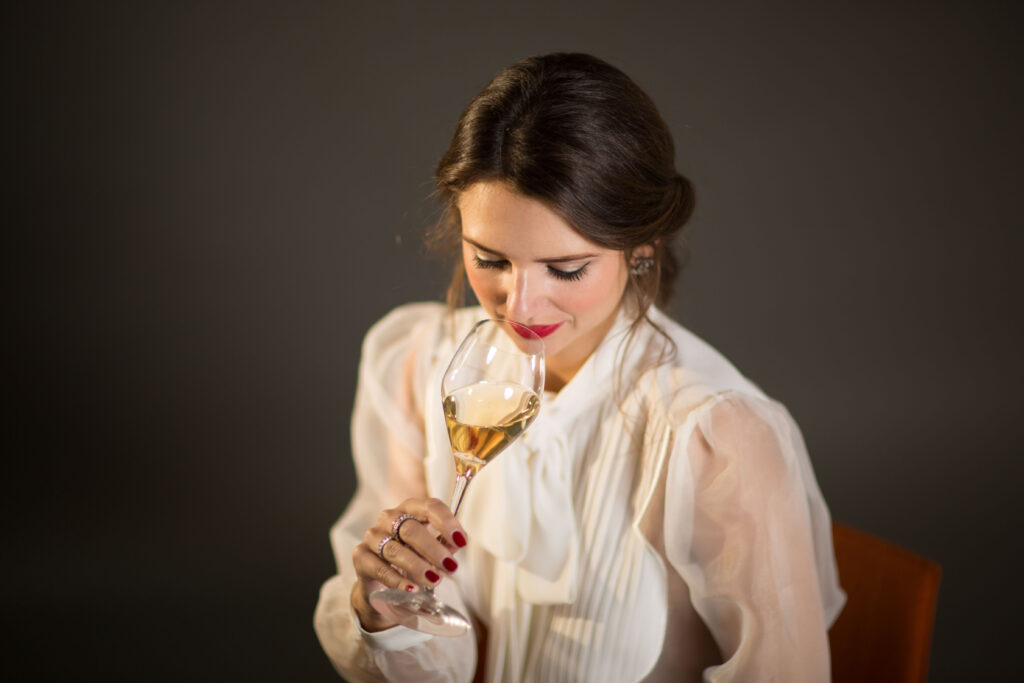
Carola Braggio, brand manager of Krug, tells us the history and philosophy of one of the most famous Champagne Houses in the world.
Carola, what exactly does the Krug brand manager do?
We could define my role as that of a marketing manager, but there are many other things that I deal with, beyond the strategic part. For example, I am also an ambassador of the product that I represent, I am the one who takes it around the world, makes people taste it, talks about it and tells the story of such an important Maison as Krug. To be more precise, we could say that my role is somewhere between trade marketing, marketing manager and ambassador. I certainly don't get bored!
How did you experience the lockdown in your company?
Let's say that our daily life has changed a lot: we brand managers could no longer organize events or present our product live, so we studied an alternative plan made up mainly of digital activities. Krug has been at the forefront in this sense. Personally, I focused a lot on online tastings, organizing an event on Instagram that involved all our ambassadors in a large meeting to celebrate Krug also virtually. It was a way to tell our customers "we are here".
You also created the Krug Connect, can you tell us about it?
Of course. All the online activities we have carried out have pushed the Maison to launch a program of initiatives on Zoom called Krug Connect. We do training, we taste, we travel the world virtually and we also present new products such as the Krug Grande Cuvée 168ème Édition, the 168th blend since the foundation of the Maison, the best possible Champagne created in 2012, regardless of the weather conditions, and unveiled to the world in April.
Now that the restrictions are less, will you go back to doing events?
It's true, there are fewer restrictions, but we still have to be very responsible at this time. In the past months, even after the lockdown, we continued to use the digital platform, but integrated it with an increasingly constant physical presence. We called this evolution "phygital", that is, between digital and physical. We organized a pioneering event at the Ambassade Piedigrotta in Varese, with Olivier Krug himself connected and holding a live tasting and, to follow, a dinner during which I was able to interact with the guests in person again, always with the necessary precautions. In any case, the planning of a calendar of events with guests and journalists, as we did before Covid, will not happen until next year.
Can you tell us a little about Krug's philosophy?
For Krug, Champagne is synonymous with pleasure, emotion and never with technicality. What is important in each bottle is what it leaves us, not so much the technical characteristics of the Champagne, and this is also why we usually do tastings with musical accompaniment. Krug Grande Cuvée, for example, is an orchestra, an assembly of many different vintages, and for each orchestra there is a director who auditions about 400 musicians (which would be the wines at his disposal, between those of the current vintage and the reserve ones) and chooses the ones most suited to his orchestra. For the latest edition, 198 wines were chosen for the Grande Cuvée and therefore for the final symphony.
Tell us about the range.
In addition to the Grande Cuvée, there are two great soloists: Clos du Mesnil, a 100% Chardonnay that is produced in just under two hectares of vineyard, and Clos d'Ambonnay, a 100% Pinot Noir that comes from 0.68 hectares of vineyard. These are two extraordinary products; to use the musical metaphor, we could call them musicians who play the music of the current year from a single grape from a single plot of land. They are soloists, the purest version of a single vineyard, a single grape, a single year. Then there is our Millesimato, produced only from grapes from the same vintage and traceable to that group of musicians who play the same instrument in an orchestra. Krug Collection is the second life of the Millesimato, which spends 25 to 30 years on the lees. Finally, out of the chorus, there is Krug Rosé, the most unconventional, the one that was not in the dreams of the founder but of the fifth generation of Krug. It is said that until the 1980s, Monsieur Paul Krug, the fourth generation, had no intention of opening the doors to a rosé, despite the requests of his sons Henry and Remi. So, the latter began producing it in great secrecy in 1976 and let him taste it, without telling him what it was, in 1983. The response, according to sources, was: "Guys, we have a problem: someone is copying Krug!". Once the "deception" was revealed, Monsieur Krug gave his approval to the production of Krug Rosé, because before being a rosé, it was a worthy Krug Champagne.
[:]